
The global food delivery mobile application market was valued at $6,752.32 million in 2020, and is projected to reach $62,836.97 million by 2030, growing at a CAGR of 25% from 2021 to 2030.
High internet penetration and increase in adoption of smartphones boost the growth of the global market. In addition, changing lifestyle in developing countries positively impacts the growth of the market. However, lack of high-speed connectivity in developing and underdeveloped regions and uncertainty of enterprises in developing their own applications hamper the food delivery mobile application market growth. On the contrary, rise in investment on digitalization and increase in alliances and collaborations of various restaurants with the application developers are expected to offer remunerative opportunities for expansion of the market during the forecast period.
Food delivery mobile application is a novel platform for restaurants, franchisees, and other food-selling proprietors to offer a convenient way of providing consumers with a wide range of options through a single online mobile portal. The business of delivering restaurant meals at consumers’ place has gone through a lot of improvement from telephone-based ordering system to takeout counters, and now websites and mobile applications. The food delivery mobile application offers access to single or multiple restaurants through a single online portal, where consumers can compare menus, prices, offers, and reviews given by experienced consumers.
Furthermore, the mobile applications are being developed for food delivery providers who act as a middleman between a restaurant and a consumer. These food delivery mobile applications offer various advantages, including cost savings, high profit margins, high return on investments (ROI), high customer retention, and global reach. This has allowed key market players to increase their market presence in local as well as international markets with high growth perspectives.
The food delivery mobile application market is segmented on the basis of deployment platform, end user, and region. On the basis of deployment platform, the market is segmented into Android, iOS, and others. The end-user segment, the market is bifurcated into food delivery market place and restaurants & others. On the basis of geography, the market is analyzed across North America, Europe, Asia-Pacific, and LAMEA.
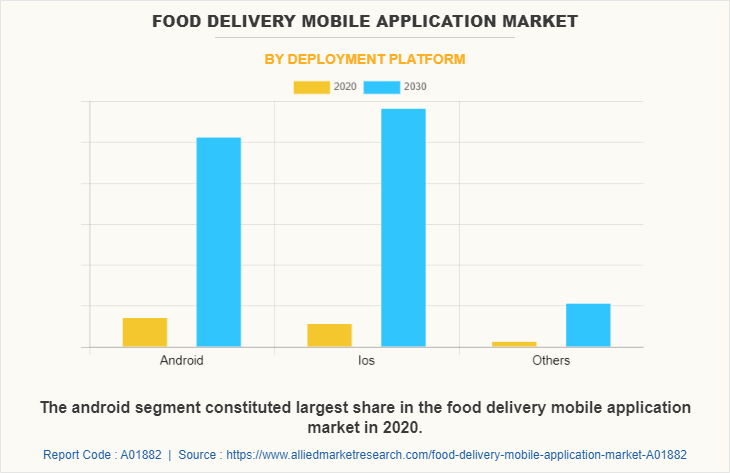
In terms of deployment platform, the android segment holds the largest food delivery mobile application market share, owing to large number of android users as compared to another type of operating system. However, the iOS segment is expected to grow at the highest rate during the forecast period, owing to global digitization, cross-device development, accessible designer tools, and monetization (viability of paid app downloads) are expected to fuel the market growth of the food delivery mobile application market based on iOS platform.
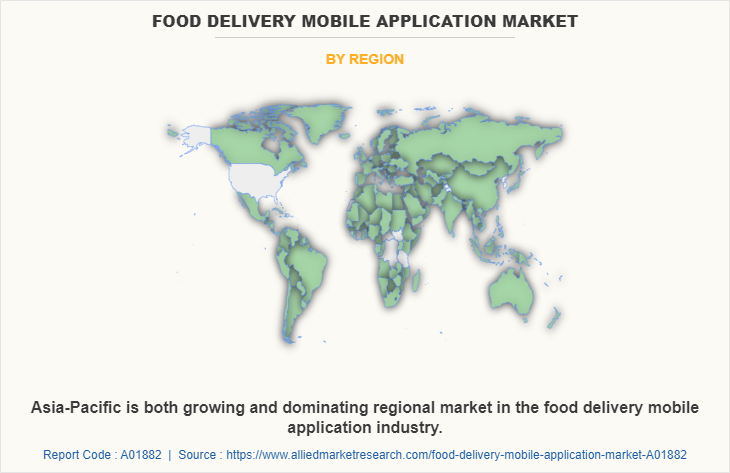
Region-wise, the food delivery mobile application market size was dominated by Asia-Pacific in 2020, and is expected to witness significant growth during the forecast period, owing to countries, such as China, India, Japan, and Australia. Many global and domestic food service players, including Zomato, Foodpanda, Waimai Baidu, and others operate in the Asia-Pacific market owing to increase in penetration of smartphones in the region which has resulted in improved food delivery models.
The key players that operate in the food delivery mobile application industry are Apple Inc., CA, Inc. (Broadcom), Cognizant, Google Inc., IBM Corporation, Mendix, Microsoft Corporation, Red Hat, Inc., SAP SE, and Zoho Corporation Pvt. Ltd.
The food delivery mobile application industry is strongly driven by rapid increase in Internet penetration, especially, in developing countries, such as Brazil, India, China, and others. In recent years, individuals have adopted Internet as a prime medium of communication through various devices, such as smartphones, tablets, and laptops. Internet allows easy access to restaurants or franchises with minimum effort and cost. In addition, the number of online buyers has significantly increased owing to growth in the e-commerce industry, product assortment, and convenience offered by the vendors, and various discounts that are available only on e-platforms. Moreover, network providers offer various offers or plans regarding Internet, which decreases the costs of Internet even more and can easily be made affordable in underdeveloped or developing countries.
Smartphones is one of the highly appreciated mediums of communication, on which food delivery mobile applications are being launched in the market by key vendors. It gives users a platform to install the application and use it to get food delivery services from nearby restaurants, hotels, or franchises. Technological advancements in smartphones and their declining prices have increased their demand globally. This has urged mobile application developers and restaurant owners to collaborate and launch food delivery apps on various platforms including iOS, Windows, and Android.
The food delivery mobile application market size has grown significantly in recent years; but, due to the outbreak of the COVID-19 pandemic, the market is expected to experience a sharp decline in 2020. This is due to governments implementing lockdown in the majority of countries and halt in travel across the globe to prevent the spread of the virus. Following the recovery from the COVID-19 pandemic, the food industry is expected to grow in the next coming years. Various firms globally have implemented a work-from-home culture for their staff, resulting in rise in demand for ready to eat food, which is expected to increase growth in the market.
From an economic standpoint, online food delivery has been criticized for high commissions it charges restaurants and questionable working conditions for delivery people while providing job and sale opportunities. From a social perspective, online food delivery affects the relationship between consumers and their food, while influencing public health outcomes and traffic systems. Environmental impacts include, the generation of worrying amounts of waste and its high carbon footprints. Stakeholders must consider how best to mitigate the negative and promote the positive impacts of online food delivery to ensure that it is sustainable, in every sense,
